When launching an online casino, one of the biggest decisions isn’t choosing software—it’s choosing your business model.
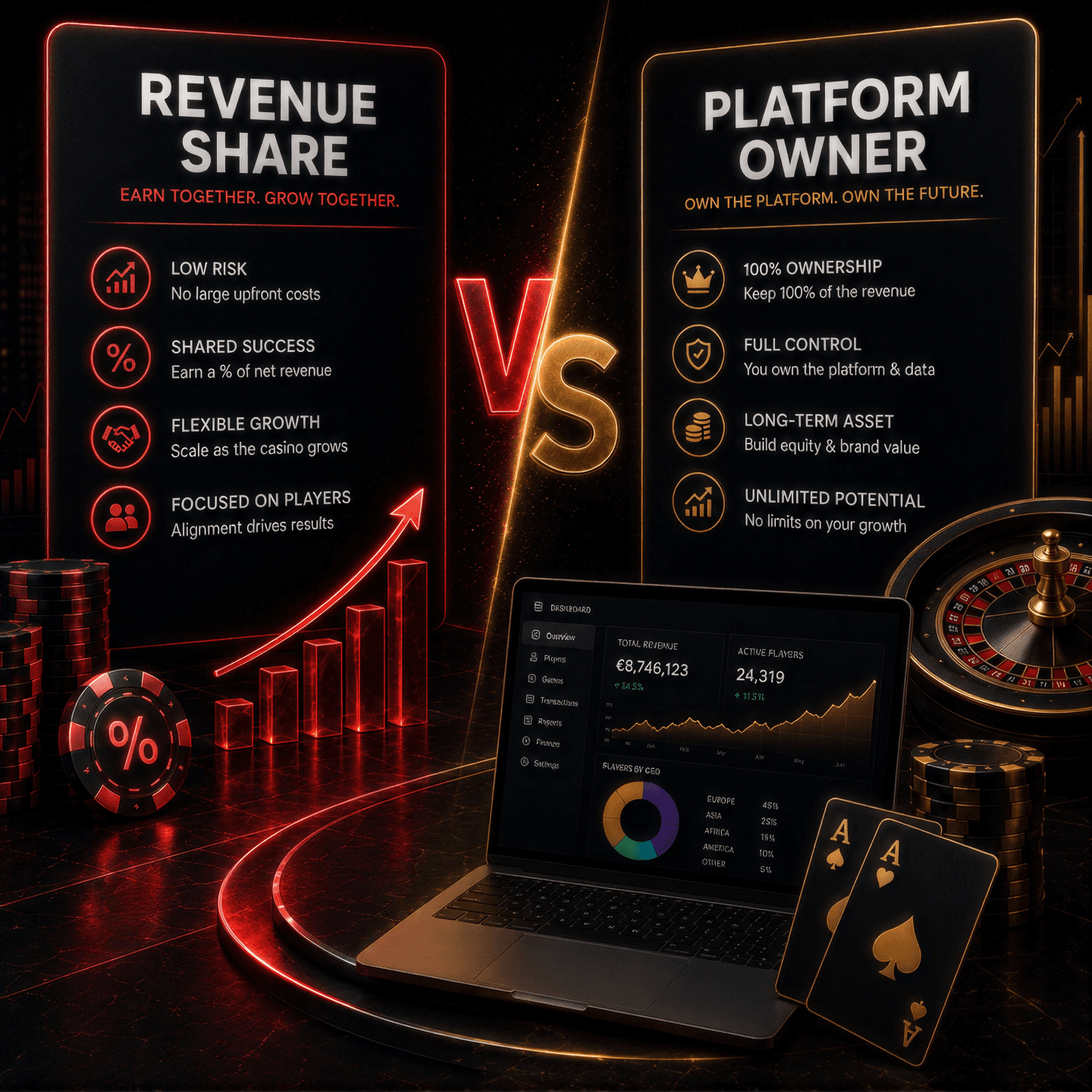
Many platform providers offer a revenue share agreement, while others offer solutions that give operators greater control over the platform they use.
Both models can be successful.
The right choice depends on your business goals, available capital and long-term strategy.
This guide explains how each approach works and what founders should consider before making a decision.
What Is a Revenue Share Model?
In a revenue share agreement, the platform provider receives an agreed percentage of the casino’s revenue.
Instead of paying a large upfront investment, operators share part of their ongoing earnings with the provider.
Revenue share agreements are common within the iGaming industry because they reduce the initial financial commitment required to launch.
The exact structure varies between providers, but the principle remains the same—the platform provider participates in the long-term revenue generated by the casino.
How Revenue Share Works
A typical revenue share arrangement follows this model:
The operator:
- Builds the brand
- Acquires players
- Markets the casino
- Manages customer support
- Operates the business
The provider:
- Supplies the platform
- Maintains the infrastructure
- Provides updates
- Supports integrations
- Maintains security
- Delivers ongoing technical support
In return, the provider receives an agreed percentage of revenue according to the commercial agreement.
What Is Platform Ownership?
Platform ownership follows a different approach.
Rather than sharing revenue indefinitely, the operator invests in technology that becomes part of their long-term business infrastructure.
Depending on the solution, ownership may include:
- Platform infrastructure
- Backend systems
- Frontend
- Wallet systems
- CRM
- Reporting
- Integrations
- Brand assets
This provides greater operational independence as the business grows.
Comparing the Two Models
Initial Investment
Revenue Share
Generally requires a lower upfront investment.
This makes it attractive for businesses entering the market with limited capital.
Platform Ownership
Usually requires a larger initial investment but may reduce long-term dependence on recurring commercial agreements.
Ongoing Costs
This is where the models differ most significantly.
With revenue share, the provider continues receiving a percentage of revenue for the duration of the agreement.
Platform ownership generally shifts more of the investment to the beginning of the project, with ongoing costs focused on hosting, maintenance, support and future development rather than revenue participation.
Business Growth
As player numbers increase, both models continue to support growth.
However, operators should consider how their commercial agreement evolves as revenue increases.
Understanding future costs is just as important as understanding launch costs.
Flexibility
Revenue share agreements often follow the provider’s commercial framework.
Platform ownership generally offers greater flexibility when expanding into:
- Additional brands
- New jurisdictions
- New payment providers
- Additional game providers
- Custom functionality
- Proprietary products
Technology Control
Revenue share platforms are typically maintained by the provider.
Platform ownership allows operators to have greater influence over the future direction of their technology stack.
This may become increasingly valuable as businesses mature.
Long-Term Business Value
Many founders think only about launch costs.
Successful operators also consider long-term business value.
Technology infrastructure can become an important strategic asset, particularly for businesses planning to expand, attract investment or develop multiple brands.
Side-by-Side Comparison
Feature Revenue Share Platform Ownership Initial Investment Lower Higher Ongoing Revenue Payments Usually Yes Usually No Technology Control Limited Greater Scalability Good Excellent Multiple Brands Depends on Provider Greater Flexibility Platform Independence Lower Higher Long-Term Flexibility Moderate High Strategic Asset Limited Yes
Which Model Is Right for You?
A revenue share model may suit businesses that:
- Want to reduce upfront costs
- Prefer predictable launch expenses
- Want the provider to manage most technical responsibilities
- Are testing a new market
- Prefer outsourcing infrastructure
Platform ownership may suit businesses that:
- Plan for long-term growth
- Expect to launch multiple brands
- Want greater technology control
- View infrastructure as a strategic asset
- Prefer greater operational independence
The best choice depends on your commercial objectives rather than a single “right” answer.
Questions to Ask Before Signing
Before entering any commercial agreement, consider:
- How is revenue calculated?
- What percentage will be shared?
- Are there minimum commitments?
- What additional fees apply?
- Can the agreement be exited?
- What happens if the business grows significantly?
- Who controls future development?
- Who owns the technology?
Understanding these details helps avoid unexpected surprises later.
Key Takeaways
Revenue share and platform ownership represent two different approaches to building an online casino.
Revenue share lowers the initial barrier to entry by exchanging part of the ongoing revenue for access to established technology and support.
Platform ownership places greater emphasis on long-term flexibility, control and independence.
Choosing between them should involve evaluating both immediate requirements and long-term business goals.
Frequently Asked Questions
What is revenue share in an online casino?
Revenue share is a commercial agreement where the platform provider receives an agreed percentage of the casino’s revenue in exchange for providing technology, infrastructure or services.
Is revenue share better than owning a platform?
Neither model is universally better. Revenue share reduces upfront costs, while platform ownership offers greater long-term control and flexibility.
Does platform ownership eliminate all ongoing costs?
No. Operators should still expect ongoing expenses such as hosting, maintenance, support, compliance and future development. The difference is that these costs are generally separate from sharing operational revenue.
Which model is best for long-term growth?
Businesses planning significant expansion often evaluate whether greater technology control and operational flexibility align with their long-term strategy.