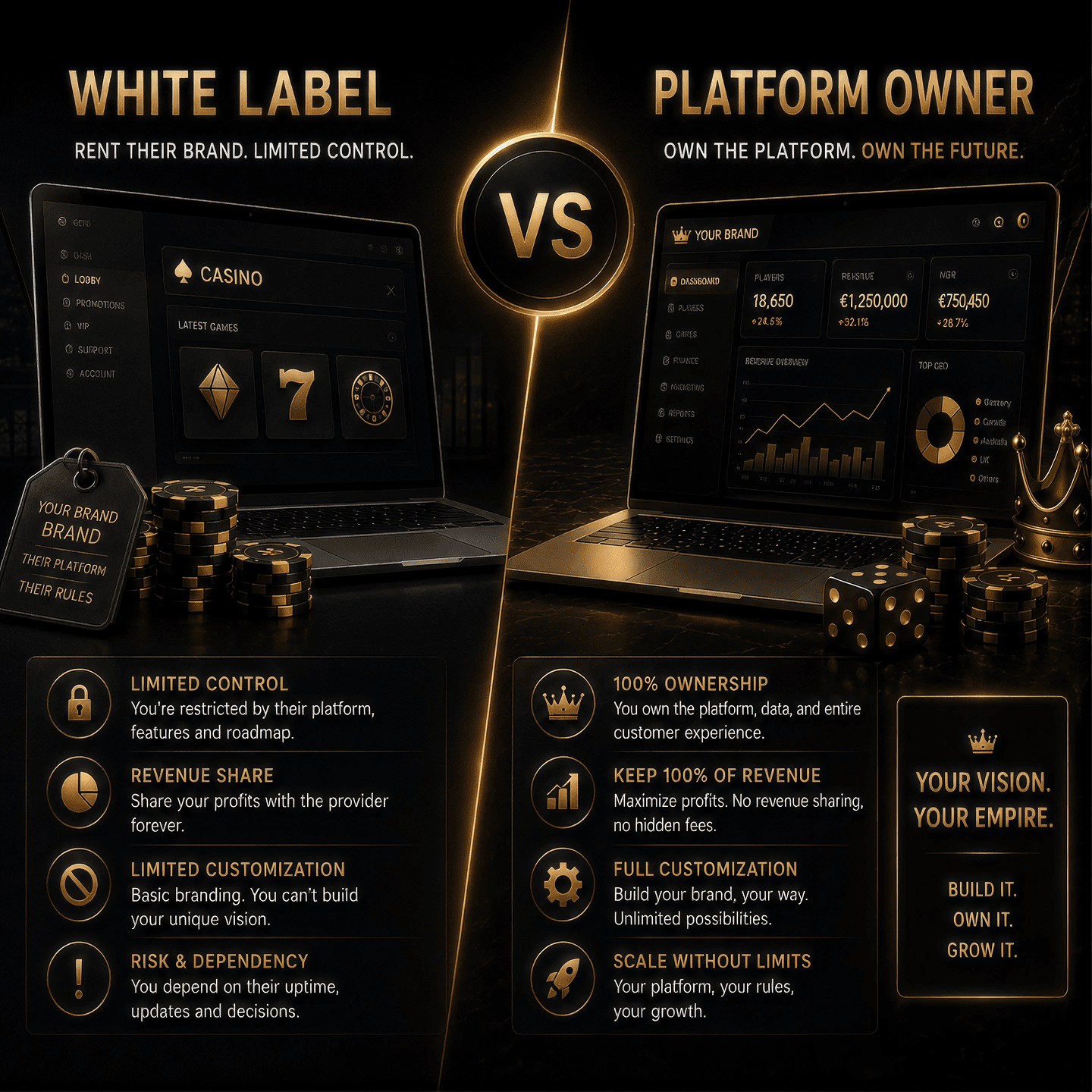
One of the biggest decisions every casino founder faces is whether to launch using a white label platform or invest in platform ownership.
Both approaches can successfully launch an online casino.
The difference lies in who controls the technology, how your business grows and what happens over the next five to ten years.
Understanding these differences early helps you choose the model that best fits your long-term goals.
What Is a White Label?
With a white label solution, another company owns, develops and maintains the platform.
You receive access to the software under your own brand while paying ongoing fees, revenue share or both.
You focus on:
- Marketing
- Branding
- Player acquisition
- Customer support
- Business operations
The provider manages:
- Technology
- Infrastructure
- Updates
- Security
- Hosting
- Core platform development
What Is Platform Ownership?
Platform ownership means your business controls the core technology that powers your casino.
Instead of licensing a complete business, you operate using infrastructure that you control and can develop over time.
Depending on your chosen solution, ownership may include:
- Platform source code
- Backend infrastructure
- Frontend
- Wallet systems
- CRM
- Reporting
- Integrations
- Brand assets
Ownership gives businesses greater flexibility as they grow.
Comparing the Two Models
Launch Speed
White Label
Often provides the fastest route to market because the infrastructure already exists.
Platform Ownership
Modern infrastructure solutions can also provide rapid deployment, although branding, integrations and operational preparation still take time.
Winner: White Label for simplicity.
Upfront Investment
White Label
Lower initial investment.
Most costs are spread across ongoing monthly fees or revenue sharing.
Platform Ownership
Higher upfront investment but greater long-term control.
Winner: White Label for lower entry costs.
Long-Term Costs
This is where the biggest difference often appears.
With white label platforms, ongoing fees continue throughout the life of the business.
These may include:
- Monthly platform fees
- Revenue share
- Additional integrations
- Custom development
- Premium support
- Feature requests
Platform ownership usually requires greater initial investment but reduces long-term dependence on recurring platform costs.
Technology Control
White label operators generally rely on the provider’s development roadmap.
Platform owners have greater freedom to:
- Add integrations
- Introduce new features
- Expand functionality
- Optimise performance
- Build custom experiences
Winner: Platform Ownership.
Branding
Both approaches allow operators to build a unique brand.
However, platform ownership generally provides greater flexibility over how that brand evolves over time.
Scalability
As businesses grow, technology requirements become more complex.
Platform ownership often makes it easier to:
- Launch additional brands
- Enter new jurisdictions
- Integrate new providers
- Expand payment methods
- Develop proprietary features
White label solutions can also scale, but operators remain dependent on the provider’s infrastructure and roadmap.
Business Value
Technology is an asset.
Businesses that own their technology infrastructure may create additional long-term enterprise value beyond day-to-day operations.
Ownership can also provide greater strategic flexibility when expanding, attracting investors or exploring future opportunities.
Side-by-Side Comparison
Feature White Label Platform Ownership Time to Market Excellent Excellent (with proven infrastructure) Initial Cost Lower Higher Monthly Fees Usually Ongoing Usually Lower Revenue Share Often Required Not Always Platform Control Limited High Customisation Moderate Extensive Scalability Good Excellent Multiple Brands Depends on Provider Full Control Technology Ownership No Yes Long-Term Flexibility Moderate High
Which Option Is Right for You?
A white label solution may suit businesses that:
- Want to launch quickly
- Prefer outsourcing technology
- Have limited technical resources
- Are testing a new market
- Prefer lower upfront investment
Platform ownership may suit businesses that:
- Want long-term control
- Plan to launch multiple brands
- Expect significant growth
- Want greater flexibility
- View technology as a strategic asset
Neither model is universally better.
The right decision depends on your business goals, available capital and long-term vision.
Questions to Ask Before Choosing
Before making a decision, consider:
- Who owns the technology?
- What recurring costs will I pay over five years?
- Can I customise the platform?
- Can I add my own integrations?
- What happens if I outgrow the provider?
- Can I launch multiple brands?
- How much control do I want over my business?
Answering these questions often provides more clarity than simply comparing launch costs.
Key Takeaways
Both white label platforms and platform ownership provide viable paths into the online casino industry.
White label solutions prioritise convenience, lower upfront costs and faster deployment.
Platform ownership focuses on flexibility, scalability and long-term strategic control.
Understanding the differences helps founders choose a model that aligns with both their immediate objectives and future ambitions.
Frequently Asked Questions
Is a white label casino cheaper?
White label platforms generally require a lower initial investment, although recurring fees and revenue sharing can increase long-term costs.
Do I own the technology with a white label solution?
In most cases, no. The platform provider retains ownership of the core technology.
Can I customise a white label platform?
Branding is usually customisable, but deeper platform functionality may be limited depending on the provider.
Is platform ownership only for large companies?
Not necessarily. Many modern infrastructure solutions make platform ownership accessible to businesses that want greater long-term control without developing every component from scratch.